Evolvement LLC logo

Python in Databricks

Scalable data engineering, analytics, machine learning, simulation, GPU compute, notebooks, app code, pipelines, jobs, and reporting solutions built with Python in Azure Databricks.

What We Build

  • Python notebooks for data engineering, analytics, simulation, forecasting, and machine learning workflows.
  • GPU-enabled Databricks compute for model training, LLM inference, embeddings, and high-performance analytics.
  • Databricks Repos and workspace files including app.py, index.html, notebooks, libraries, and configuration files.
  • Parallel Jobs and Workflows that run ingestion, feature engineering, model scoring, and output publishing at scale.
  • Delta Live Tables and pipeline patterns for bronze, silver, and gold data layers.
  • Databricks outputs to Azure SQL, Cosmos DB, PostgreSQL, Power BI, ML Studio, AI agents, and operational dashboards.

Example Use Cases

  • Train and score XGBoost, forecasting, or classification models using Python notebooks and Spark dataframes.
  • Run GPU-backed inference for Mistral, TinyLlama, embeddings, document analysis, and RAG workflows.
  • Read source data from Azure SQL, APIs, files, and Cosmos DB, then write curated outputs to Delta tables.
  • Package Databricks-backed Flask or Python web apps using app.py and index.html files.
  • Run parallel pipelines that feed historical dashboards, ML predictions, persistent learning, and AI agents.

Databricks as the Python Execution Layer

Databricks provides a scalable Python execution layer where notebooks, jobs, pipelines, files, GPU compute, and Delta tables work together. Evolvement LLC uses Databricks to transform raw data into analytics-ready, model-ready, and dashboard-ready outputs.

  • Compute: CPU and GPU clusters for interactive notebooks, production jobs, ML, embeddings, and inference.
  • Python: pandas, PySpark, MLflow, XGBoost, transformers, notebooks, reusable functions, and packaged apps.
  • Files: app.py, index.html, notebooks, JSON configs, Python modules, and deployment-ready code assets.
  • Jobs: task graphs that run ingestion, processing, scoring, and output publishing in parallel.
  • Pipelines: Delta Live Tables and curated bronze, silver, and gold data layers for analytics and learning.

Azure Databricks in Use

The screenshots below are Azure/Databricks-style visuals packaged locally with this page so they render reliably. They show GPU compute, Python notebooks, app.py, index.html, parallel jobs, pipelines, and architecture.
Databricks GPU compute cluster

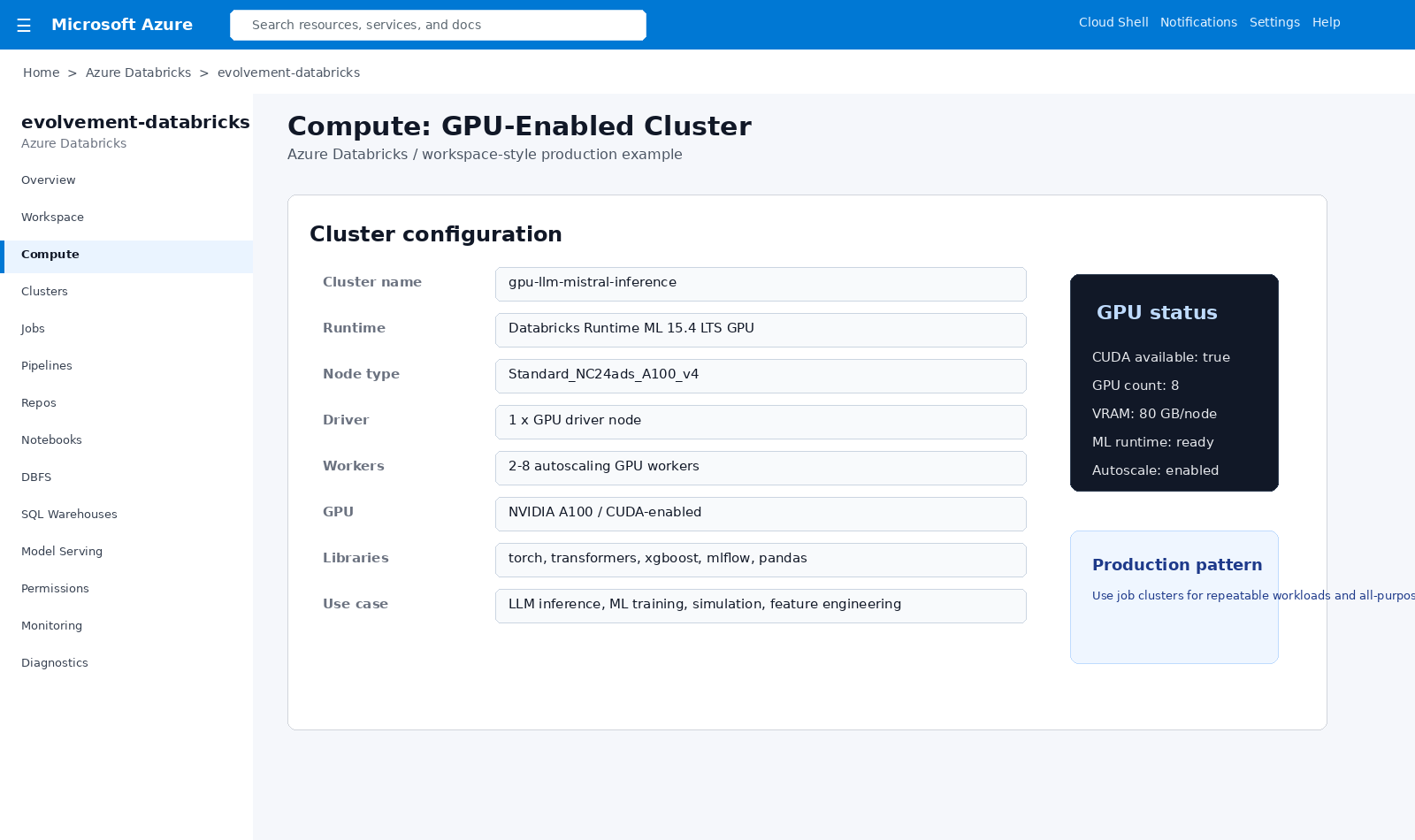
GPU Compute Cluster

GPU-enabled Databricks compute for LLM inference, ML training, embeddings, simulation, and high-performance analytics.
Databricks Python notebook

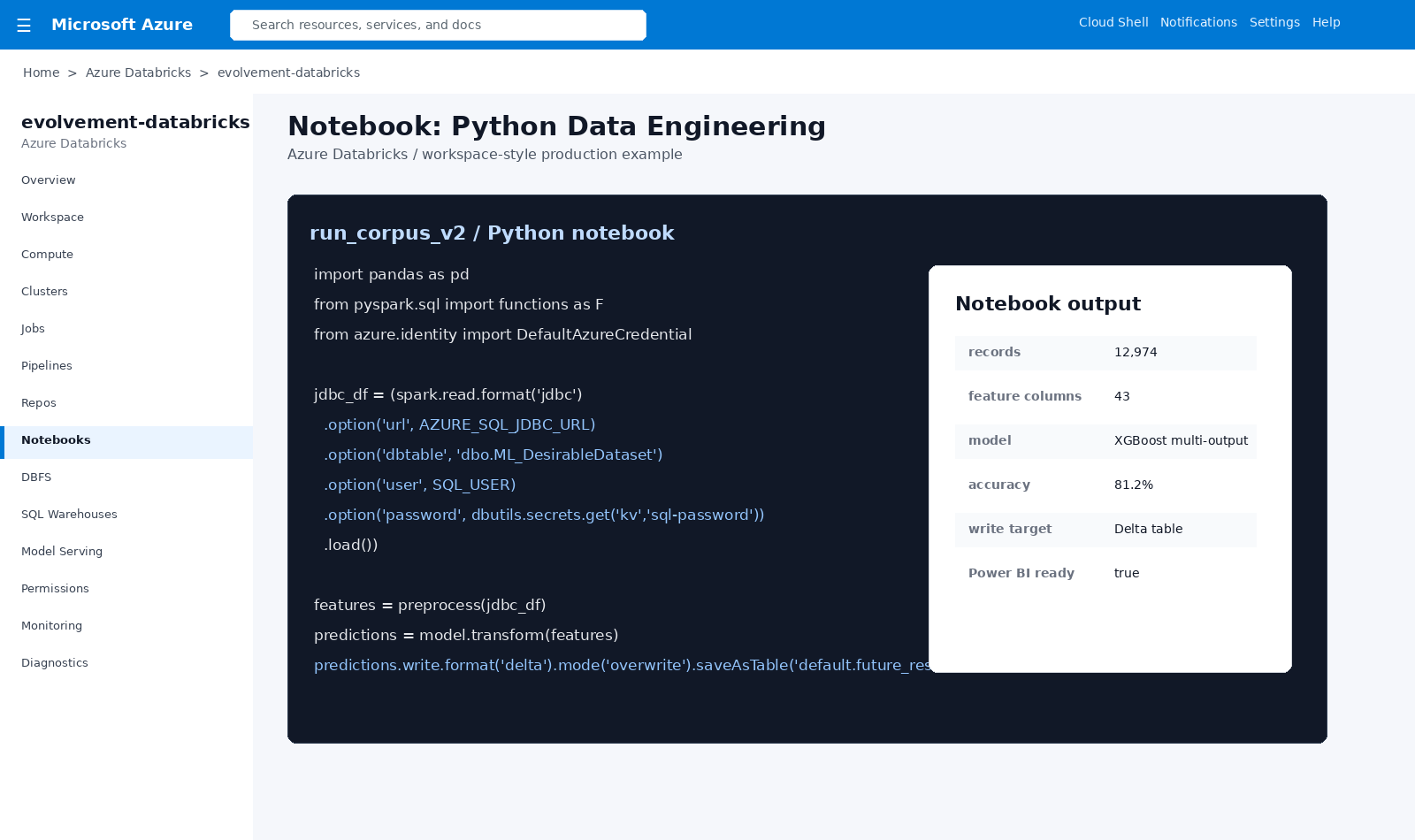
Python Notebook

Python notebook connecting to Azure SQL, transforming data, scoring models, and writing curated Delta results.
Databricks app.py workspace file

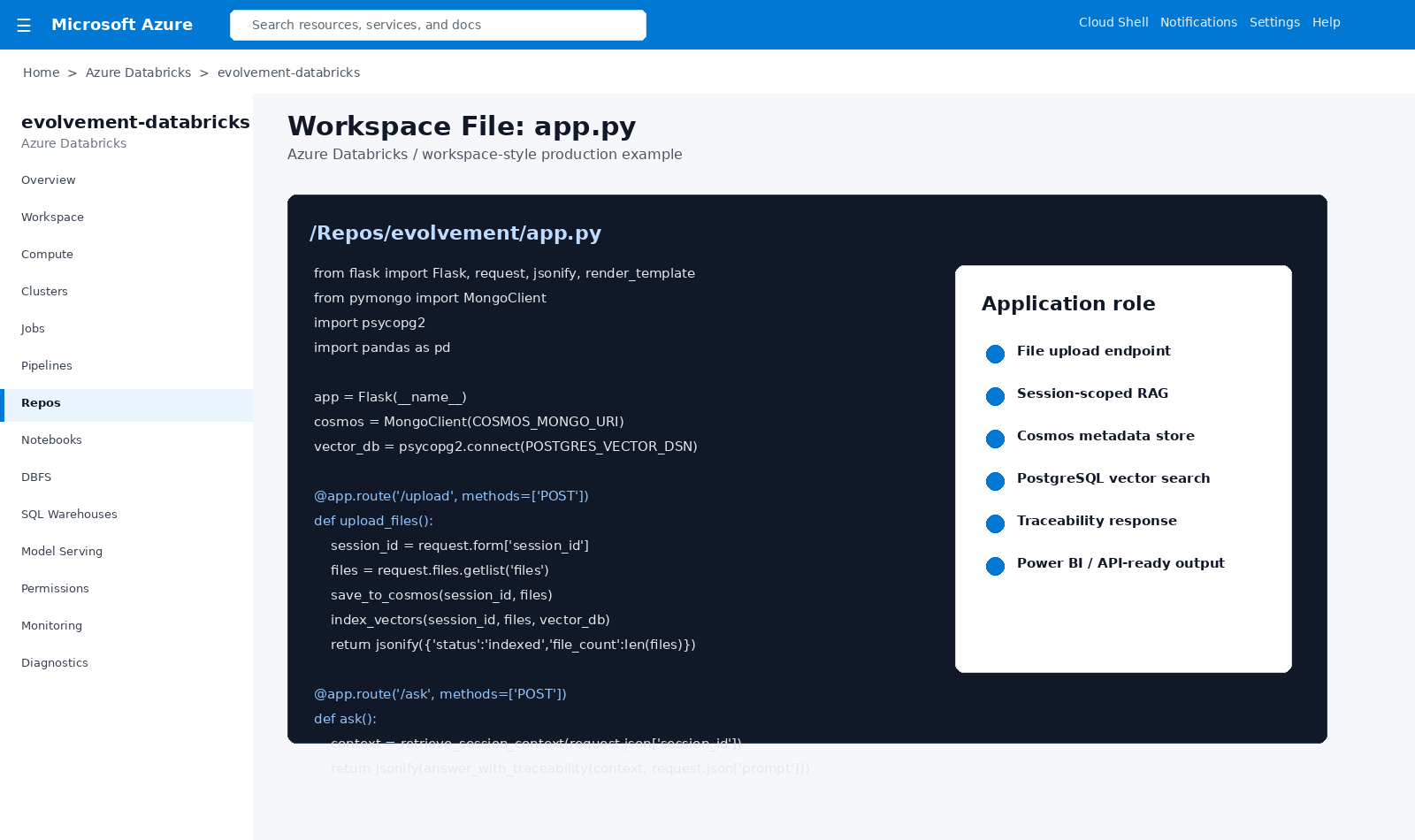
app.py Application File

Python web app code for upload, Cosmos storage, PostgreSQL vector search, RAG, and traceability endpoints.
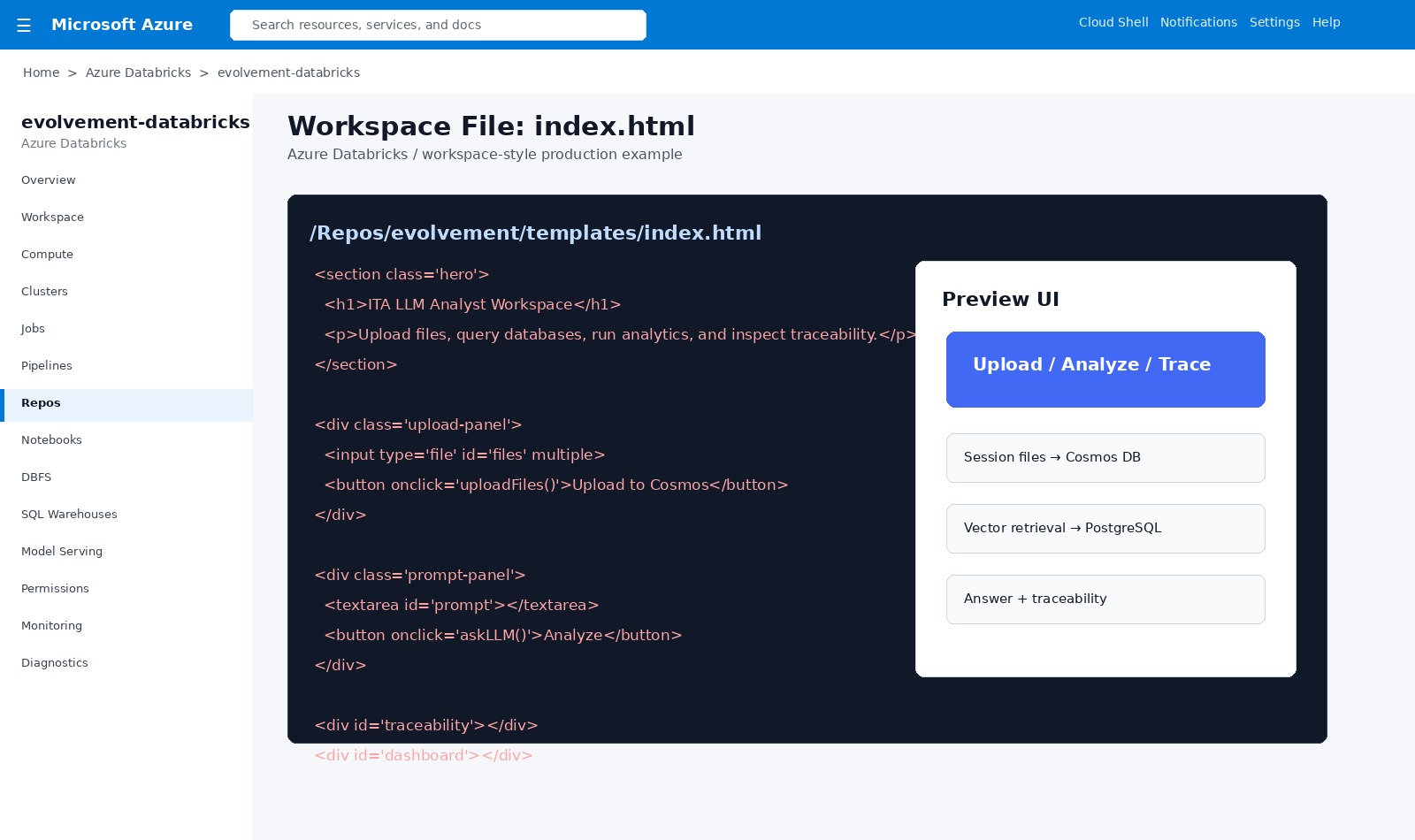
Databricks index.html workspace file

index.html Front End

HTML front-end file supporting uploads, prompts, analysis, dashboards, and traceability display.
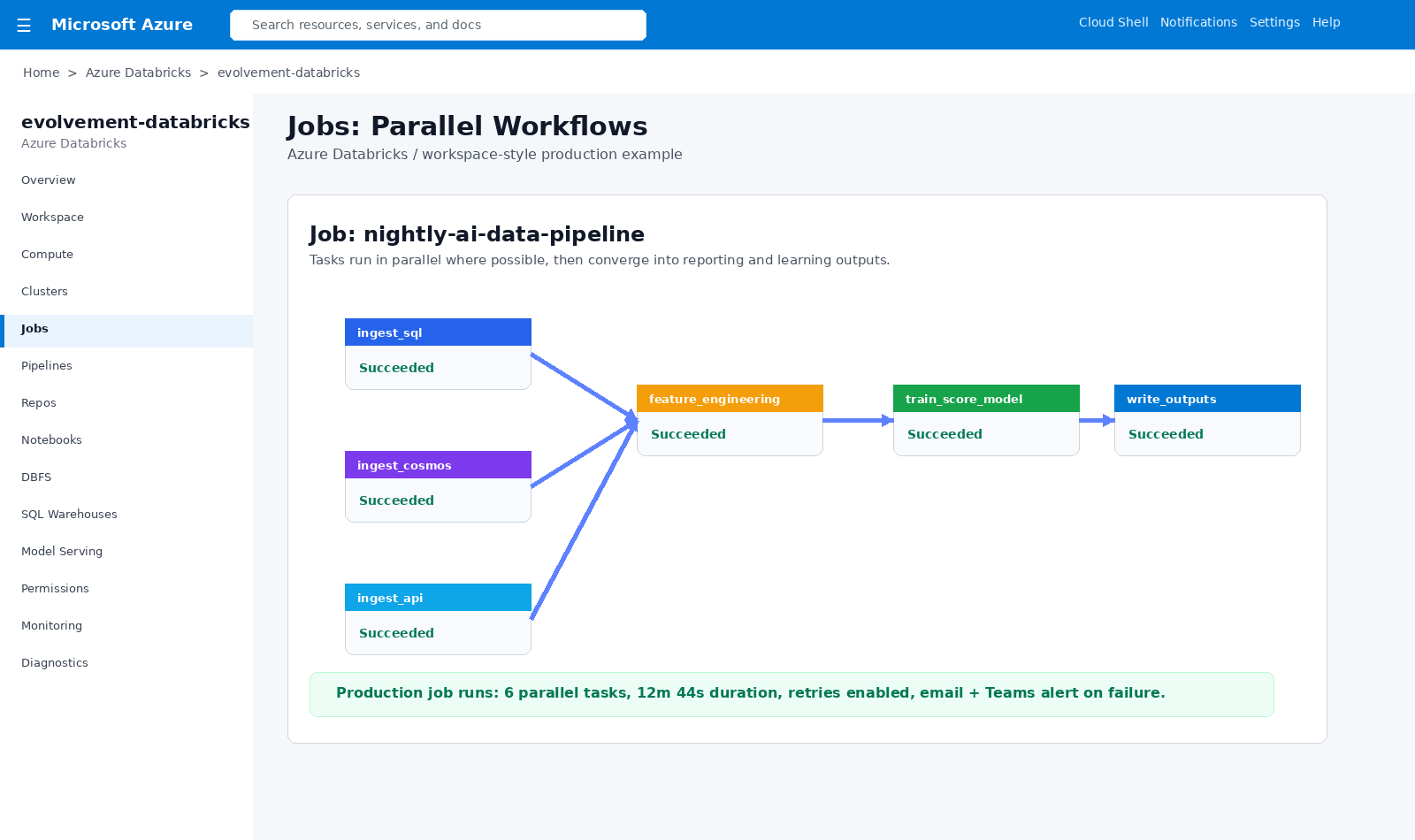
Databricks parallel jobs

Parallel Jobs and Workflows

Parallel job graph running SQL, Cosmos, and API ingestion before converging into feature engineering and model scoring.
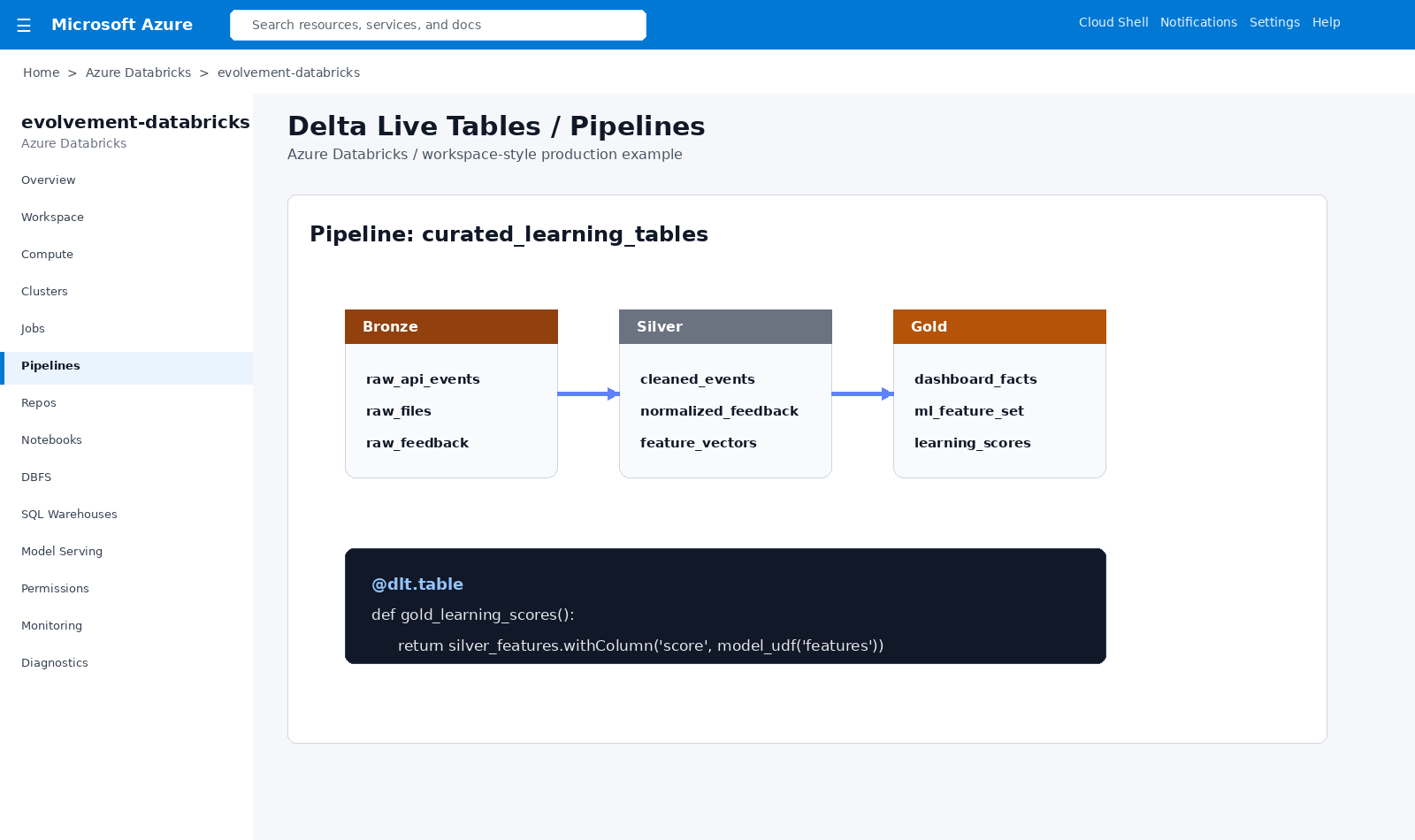
Databricks pipelines Delta Live Tables

Pipelines and Delta Live Tables

Bronze, silver, and gold pipeline pattern for curated tables, ML features, dashboard facts, and learning scores.
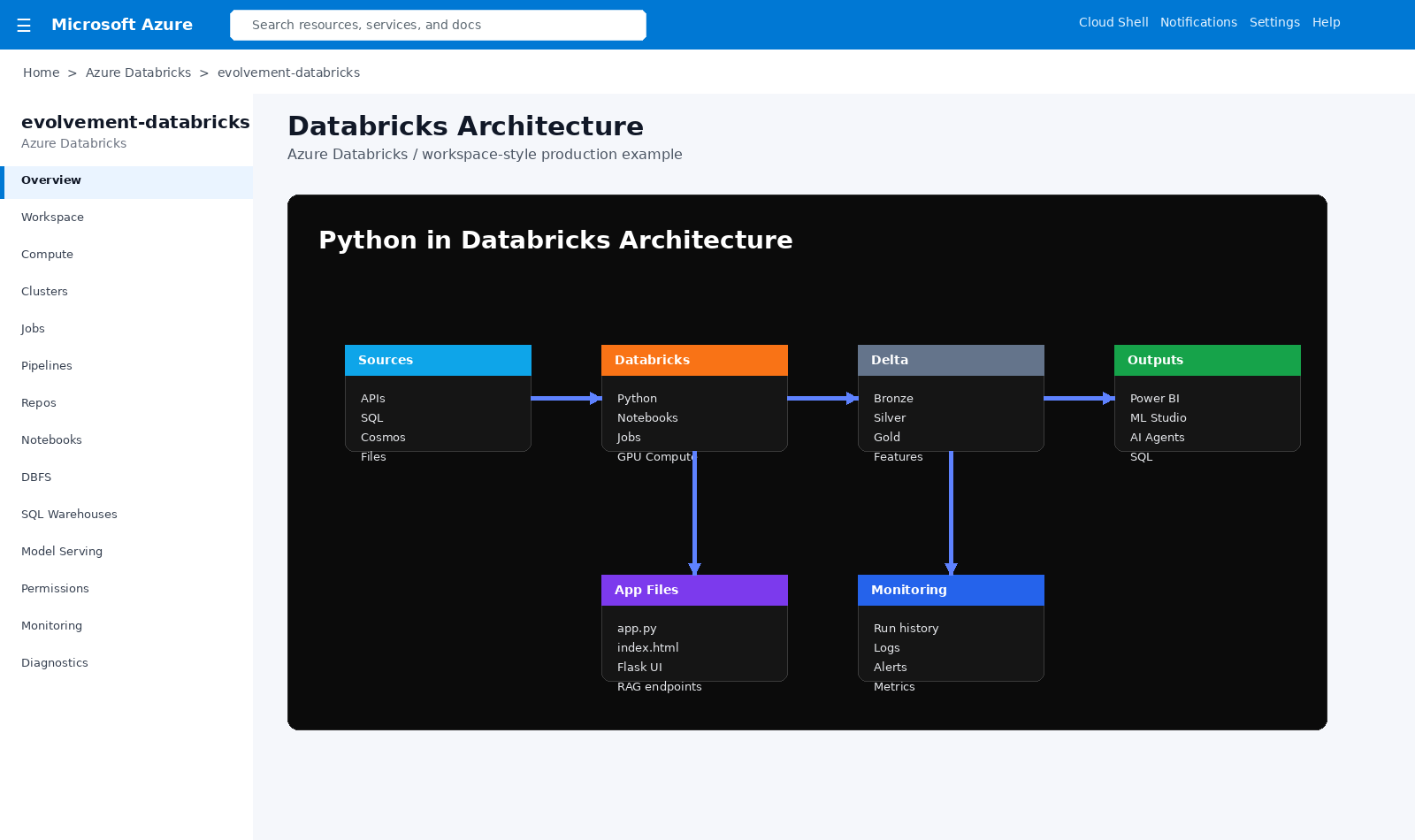
Databricks architecture flow

Databricks Architecture Flow

Sources, Databricks, Delta, app files, monitoring, Power BI, ML Studio, and AI agents connected into one data platform.

Architecture Flow

Sources

Azure SQL, APIs, Cosmos, files, streams, and operational systems.

Compute

CPU and GPU Databricks clusters for notebooks, jobs, ML, and inference.

Python

Notebooks, app.py, PySpark, pandas, MLflow, XGBoost, transformers, and utilities.

Pipelines

Jobs, workflows, parallel tasks, Delta Live Tables, and bronze/silver/gold layers.

Outputs

Delta tables, Azure SQL, PostgreSQL vectors, Power BI, ML Studio, and AI agents.

This pattern gives organizations a scalable Python execution environment where Databricks handles data engineering, machine learning, GPU workloads, parallel jobs, web application code, notebooks, and production outputs from one governed workspace.

Business Value

  • Scalable processing for large datasets, advanced analytics, ML, and simulation workloads.
  • GPU options for model training, embeddings, and LLM inference.
  • Reusable notebooks and code files that move from prototype to production jobs.
  • Parallel job execution that reduces processing time and improves reliability.
  • Curated outputs for dashboards, predictions, persistent learning, and AI applications.

Example Production Flow

  • Databricks job triggers on a schedule or from Data Factory.
  • Parallel tasks ingest Azure SQL, Cosmos, API, and file data.
  • Python notebooks clean, transform, enrich, and engineer features.
  • GPU compute runs model training, embeddings, or inference where needed.
  • Delta pipeline publishes bronze, silver, and gold tables.
  • Outputs feed Power BI, ML Studio, PostgreSQL vectors, AI agents, and operational apps.
Back to Capabilities